Metro Bangalore
Metro Bangalore, officially known as Namma Metro, stands as a transformative force in the city’s transit landscape. As South India’s first underground metro, it now stands as the second-longest operational metro network in the country, just after the Delhi Metro. With a network length of 76.9 km, it connects key locations across Bangalore using a combination of elevated, underground, and at-grade tracks, ensuring seamless travel across the city. Operated by the Bangalore Metro Rail Corporation Limited (BMRCL), a joint venture between the central and state governments, the metro is aimed at easing traffic congestion, cutting down emissions, and boosting real estate growth around key stations across the city.
✅ Bangalore Metro Network: Stations and Structure
As of today, Namma Metro operates 68 stations across its expanding network:
- 59 Elevated Stations
- 8 Underground Stations
- 1 At-grade Station
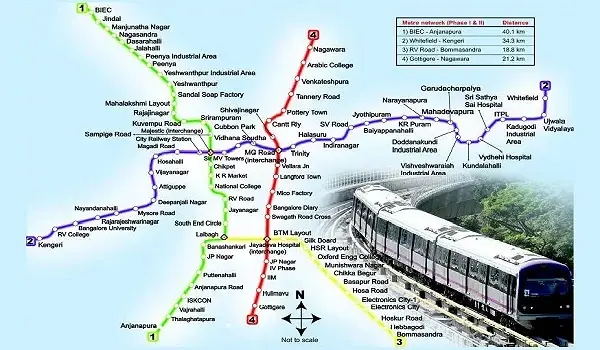
This comprehensive structure has made the Bangalore metro map an essential tool for city navigation. The design promotes easy connectivity between central business districts, emerging tech corridors, and residential hubs, enabling the network to serve as the backbone of urban mobility in Bangalore.
🎟️ Bangalore Metro Ticket Prices
Bangalore Metro fares are structured to be affordable for all commuters, making public transport more accessible:
- Minimum fare: ₹10
- Maximum fare: ₹45
- Monthly Metro Pass: ₹1,000 to ₹3,000 depending on travel distance
Whether you’re a student, a professional, or a daily wage earner, this pricing structure ensures cost-effective travel across the metro corridor.
🚇 Operational Metro Lines in Bangalore
Currently, Metro Bangalore operates two major lines: Purple Line and Green Line. Four more lines—Yellow, Blue, Orange, and Pink—are in the pipeline, promising enhanced Bangalore metro line expansion.
🟣 Purple Line
The Purple Line of Bangalore Metro stretches across 37 stations, connecting key residential and commercial zones throughout the city:
Starting from Whitefield, it passes through Channasandra, Kadugodi, Pattandur Agrahara, Sri Sathya Sai Hospital, Nallurhalli, Sitharama Palya, Hoodi Junction, and Garudacharapalya. The route continues through Mahadevapura, Kundalahalli, Swami Vivekananda Road, Indiranagar, Halasuru, Trinity, and Krishnarajapuram. It also includes important stops like Benniganahalli, Baiyappanahalli, Mahatma Gandhi Road, Cubbon Park, and Dr BR Ambedkar Station. Further west, it extends to Vijayanagara, Attiguppe, Deepanjali Nagara, Mysuru Road, Balagangadharanatha Swamiji Station, Nayandahalli, Sir M. Visveshwaraya Station, Krantivira Sangolli Rayanna Railway Station,and Nadaprabhu Kempegowda Station. The line concludes with stations at Madagi Road, Rajarajeshwari Nagar, Jnanabharathi, Pattanagere, Kengeri Bus Terminal, and Challaghatta—offering widespread connectivity and making it one of the most crucial metro corridors in Bangalore.This line plays a vital role in connecting tech parks in East Bangalore with central commercial areas, helping reduce road traffic and improving workplace accessibility.
🟢 Green Line
Covering 32 stations over 31 km, the Green Line serves the industrial and residential clusters of North and South Bangalore. Major stations include:
- This metro corridor covers a wide swath of Bangalore, connecting industrial zones, residential neighborhoods, and cultural landmarks. Starting from Madavara, the route passes through Chikkabidarakallu, Manjunathanagara, Peenya Industry, and Peenya. It continues through key stations like Goraguntepalya, Yeshwanthpura, Sandal Soap Factory, Nagasandra, Dasarahalli, Jalahalli, Mahalakshmi, and Rajajinagara. Commuters also benefit from access to Mahakavi Kuvempu Road, Srirampura, Sampige Road, and Nadaprabhu Kempegowda Station, which serves as a major interchange. As the line moves further south, it connects key locations such as Yelachenahalli, Doddakallasandra, Krishna Rajendra Market, National College, Lalbagh Botanical Garden, South End Circle, and Konanakunte Cross—enhancing access to both residential and cultural hubs in this part of the city. It also connects to popular areas such as Jayanagar, Rashtreeya Vidyalaya Road, Banashankari, Jaya Prakash Nagar, Vajarahalli, Thalaghattapura, and ends at Silk Institute, offering a comprehensive transit solution through some of Bangalore’s most vibrant and densely populated regions.
The line is key for professionals traveling between manufacturing hubs and educational institutions, providing strong metro connectivity in Bangalore suburbs.
🟡 Yellow Line
Launched on April 2, 2025, the Yellow Line spans 18 km and includes 16 metro stations. The project is being built to ease daily travel for professionals working in and around Electronic City:
- RV Road
- Central Silk Board
- Bommanahalli
- Hongasandra
- Kudlu Gate metro station
- Singasandra
- Hosa Road
- Ragigudda
- Jayadeva Hospital
- BTM Layout
- Beratena Agrahara
- Electronic City
- Konnapana Agrahara
- Bommasandra
- Huskur Road
- Hebbagodi
This line is expected to improve daily office commutes dramatically for thousands of tech workers, making it a major boost to public transport in South Bangalore.
🔵 Blue Line
The Blue Line is under development with plans to stretch 58.1 km and include 30 stations, offering direct access to Kempegowda International Airport:
- KR Puram
- Mahadevpura
- Kodibisanahalli
- Kadubeesanahalli
- Bellandur
- Ibbalur
- Agara Lake
- HSR Layout
- DRDO Sports Complex
- Doddanakundi
- ISRO
- Marathahalli
- Silk Board
- Kasturinagara
- Hebbal (interchange with Orange Line)
- Doddajala
- Horamavu
- Veerannapalya
- HRBR Layout
- Kodigehalli
- Kempegowda International Airport Terminal
- Kalyan Nagar
- Jakkur Cross
- HBR Layout
- Yelahanka
- Nagawara (Interchange with Pink Line)
- Bagalur Cross
- Kempapura
Real Estate Highlight: Tata Varnam, a thoughtfully designed residential project, is located near the upcoming Doddajala Metro Station on this line. Just 2.4 minutes away from the station, Tata Varnam provides direct access to the future airport metro line Bangalore and makes it an excellent investment for buyers seeking flats near metro stations. The transit-oriented housing in Bangalore is driving demand for developments exactly like Tata Varnam.
🟠 Orange Line
Planned under Phase 3, the Orange Line will feature 20 stations and trace the Outer Ring Road corridor:
This metro route is designed to enhance connectivity across key educational, residential, and commercial pockets of Bangalore. Starting from Jayaprakash Nagara, the line moves through Mysuru Road, Dr Ambedkar Institute of Technology, Nagarbhavi BDA Complex, and Sumanahalli Cross. It continues to Vinayaka Layout, Chowdeshwari Nagara, Kadirenahalli Cross, and Kamakya Bus Depot, before passing through Nagarabhavi Circle and Bahubhali Nagara. The corridor further connects commuters to Hebbala, Peenya, Hosakerahalli Cross, PES Institute of Technology, and Freedom Fighters Cross. Stations like Kanteerava Studio, BEL Circle, Patelappa Layout, and Kempapura round off the stretch, significantly improving access between Bangalore’s western zones and central business districts.
🌸 Pink Line
The Pink Line will comprise 18 stations, offering north-south access across central Bangalore. Major stops include:
- Kalena Agrahara
- Hulimavu
- Swagath Road Cross
- Dairy Circle
- IIM-Bangalore
- JP Nagar 4th Phase
- Jayadeva Hospital
- Langford Town
- Rashtriya Military School
- MG Road
- Lakkasandra
- Venkateshpura
- Shivaji Nagar
- Cantonment
- Pottery Town
- Tannery Road
- Nagawara
- Kadugundanahalli
With this route, the metro will better serve educational and cultural zones, creating direct access to heritage centers and academic institutions.
🕔 Metro Bangalore Timings and Frequency
Metro trains in Bangalore are known for their punctuality and reliability:
- Weekdays: 5:00 AM – 11:00 PM
- Saturdays & Holidays: 6:00 AM – 10:30 PM
- Sundays: 7:00 AM – 11:00 PM
- Peak Hour Frequency: Every 5 minutes
These timings align with work hours, offering convenience for daily metro commuters in Bangalore.
📈 Impact of Metro Bangalore on Urban Infrastructure and Housing
The Bangalore metro route 2025 will soon surpass the 200 km mark, and its impact is already visible. Residential projects near metro stations in Bangalore have seen substantial appreciation in property value. Developments such as Tata Varnam near Blue Line demonstrate how metro-connected apartments in Bangalore are driving both buyer interest and rental yield.
This growth supports a larger vision—self-sufficient metro-enabled communities. With access to schools, healthcare, shopping, and tech parks, these areas exemplify successful transit-oriented development (TOD) models.
🏁 Conclusion
Metro Bangalore is not just transforming commutes—it’s defining a smarter, more sustainable future. With upcoming lines, airport connections, and improved accessibility to real estate hubs like Tata Varnam, Namma Metro continues to set national benchmarks for urban infrastructure. As the city grows vertically and horizontally, the metro ensures that its people move forward—swiftly, efficiently, and affordably.